Product-based RFID software has matured alongside RFID technology itself. RFID is now proven, widely understood, and increasingly expected across manufacturing, logistics, retail, and government operations.
Yet despite this maturity, many RFID initiatives still struggle to move beyond pilots or early deployments.
In most cases, the problem isn’t read accuracy, tag performance, or hardware limitations.
Instead, success or failure often comes down to a fundamental decision made early on:
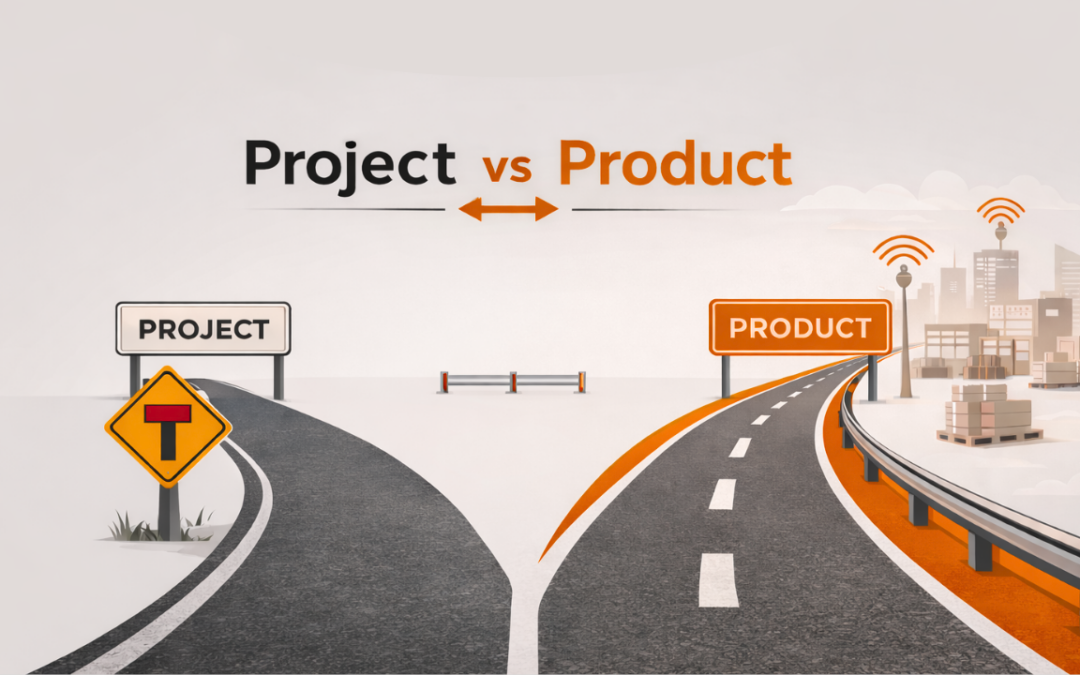
Is the RFID solution delivered as a custom project or as a product?
That choice quietly determines whether an RFID deployment becomes a scalable operational platform or remains a one-off implementation that’s difficult to justify, expand, or repeat.
What a Project-Based RFID Deployment Looks Like
In a project-based RFID deployment, each implementation is treated as a unique engagement.
The solution is designed around a specific customer environment and typically involves:
- Custom software development
- Extensive configuration and system integration
- Ongoing professional services to adjust the solution as requirements evolve
This approach can absolutely solve a specific operational problem. Many project-based deployments are technically successful.
However, they also introduce structural challenges.
Costs become harder to predict. Timelines stretch. And long-term success depends heavily on the people delivering the project rather than on the solution itself.
In practice, the project often succeeds technically but struggles commercially.
Why Custom RFID Services Increase Risk
When RFID solutions rely heavily on custom services, the center of gravity shifts away from the software and toward human effort.
As the service scope grows, several risks tend to surface:
- Unclear ROI
When software and services dominate the budget, it becomes difficult to define when, or if, value is fully realized. - Longer sales cycles
Every deployment feels like a new negotiation instead of a repeatable offering. - Scaling friction
Expanding RFID to new sites, workflows, or asset types often requires restarting the design process from scratch.
These challenges create hesitation, both for customers evaluating long-term risk and for partners deciding whether a solution is worth backing over time.
What Product-Based RFID Software Really Means
A product-based RFID software approach focuses on building a repeatable platform rather than custom, one-off implementations.
Instead of building a custom solution for each customer, the RFID software is designed as a standard, repeatable platform that:
- Supports common RFID use cases out of the box
- Is configurable without extensive custom development
- Absorbs complexity internally, rather than pushing it into services
Productized RFID platforms are built to adapt to different environments without changing the core system.
This doesn’t eliminate professional services entirely, but it ensures services support the product instead of defining it.
Repeatability, Predictability, and Scalable RFID Deployments
The biggest advantage of a product-based RFID solution is repeatability.
When the same platform can be deployed across customers, sites, and industries:
- Costs become predictable
- Deployment timelines shorten
- ROI becomes easier to explain and justify
Scale becomes additive rather than disruptive. New assets, workflows, or locations are layered onto an existing foundation instead of forcing a redesign.
This shift is what allows RFID initiatives to move from experimentation into true operational maturity.
Long-Term Impact for Customers and Partners
For customers, the difference between a project and a product shapes the entire lifecycle of their RFID investment.
Product-based RFID solutions:
- Deliver value earlier
- Evolve alongside operational needs
- Avoid locking organizations into perpetual customization cycles
- Can be sold repeatedly without re-engineering
- Reduces delivery and implementation risk
- Builds confidence during customer conversations
For partners, products create momentum. Expertise is built once and applied many times, strengthening trust and long-term relationships. Project-based deployments, by contrast, are difficult to package, price, and replicate. Each engagement feels bespoke, limiting a partner’s ability to scale their own business.
This is why channel-ready, productized RFID platforms tend to see broader adoption and longer-term growth
Ultimately, successful RFID initiatives aren’t defined by how impressive the first deployment looks, but by how easily the solution grows with the business.
Building RFID for the Long Term
Organizations that adopt product-based RFID software are better positioned to scale, standardize deployments, and achieve predictable long-term value.
As RFID adoption continues to grow, the future belongs to product-based RFID platforms, solutions designed to scale, repeat, and deliver predictable value.
If you’re evaluating RFID not just as a pilot, but as a long-term operational capability, it’s worth asking early:
Are you investing in a project or in a product?
That distinction makes all the difference.