
RFID sells itself in the first meeting. Everyone loves the promise: instant visibility, fewer manual scans, cleaner operations. However, partners and resellers know the uncomfortable truth: most RFID projects don’t get judged in the demo. Instead, they get judged two weeks after go-live, when the first “missing item” turns into the first escalation, and the first escalation turns into a stalled rollout.
That’s why the most common RFID implementation mistakes (and how to avoid them) matter more to channel teams than another feature checklist. If you can prevent a few predictable failures, you protect your reputation, reduce support burden, and most importantly, make the deployment repeatable across accounts and sites.
Mistake #1: Treating go-live like an event, not a transition
Many teams approach go-live like a finish line. They install infrastructure, confirm reads, run a quick walkthrough, and declare victory. Then reality arrives: operators work fast, exceptions appear, and the process drifts. As a result, the system looks “wrong,” even when the technology works.
Instead, you should treat go-live as a transition. Specifically, you want a structured first week where you expect issues, capture them, and resolve them quickly. Moreover, you want to publish a simple “what to do when it looks wrong” response, because uncertainty drives people back to spreadsheets. This is one of the most common RFID implementation mistakes (and how to avoid them) that quietly kill adoption.
Mistake #2: Ignoring exceptions until they explode
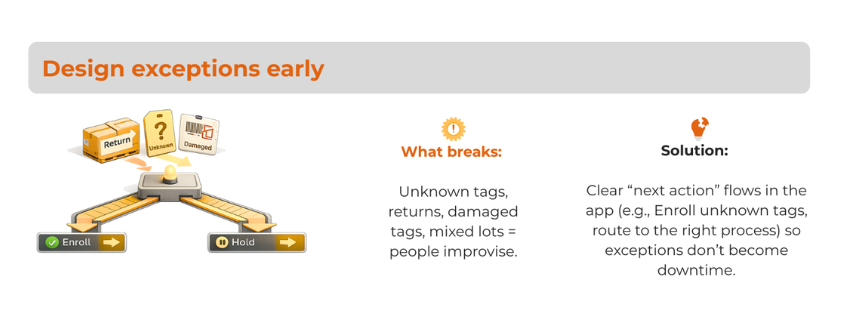
RFID projects rarely fail because the happy path doesn’t work. They fail because the unhappy path shows up constantly. Unknown tags, damaged tags, mixed lots, returns, rework loops—these are not edge cases. They are daily operations.
When you don’t design exception handling upfront, operators improvise. Then, they stop trusting the system. Consequently, the rollout becomes a “data debate” instead of an operational tool.
To avoid this, define a small exception playbook before go-live. Keep it practical: what do we do when a tag is unknown, when a kit is incomplete, when an item appears in the wrong zone, or when an expected transition never happens? After that, train those scenarios on the floor. If you do this well, you remove the #1 driver of escalations. Again, the most common RFID implementation mistakes (and how to avoid them) often come down to planning for reality, not perfection.
Mistake #3: Fuzzy handoffs between teams and steps
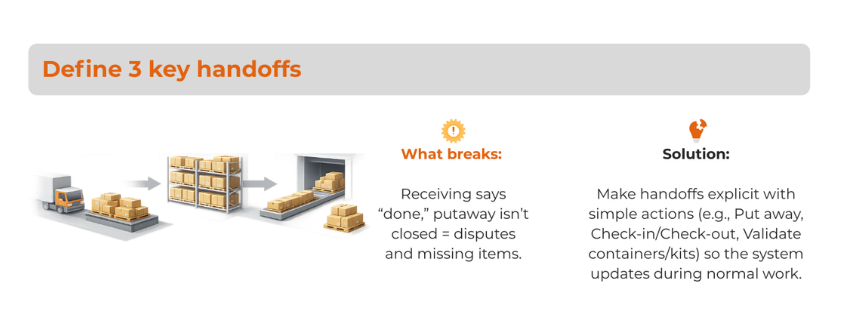
Handoffs are where assets disappear, receiving to putaway, pick to pack, pack to staging, and shift changes. Unfortunately, many implementations never define the “moment of truth” that closes a handoff. People assume someone else will do it. Then, when something goes missing, nobody owns the step.
So, instead of mapping every workflow in the universe, pick three critical handoffs. Next, define a single confirmation action that closes each handoff. Finally, assign ownership: who closes it, where, and when? This approach keeps operations moving and gives you a clear trail when disputes happen. For partners, this reduces the back-and-forth that consumes presales and support time. In other words, it directly addresses the most common RFID implementation mistakes (and how to avoid them) from a channel perspective.
Mistake #4: “Zone design” that works in a lab, not on the floor
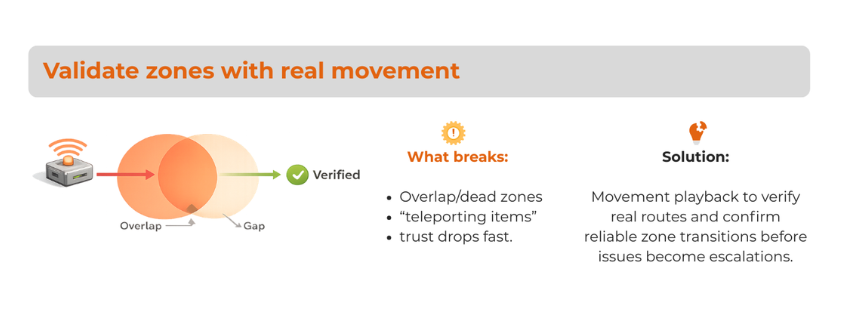
Teams often validate reads in controlled conditions. Then, they go live and see “teleporting items” (overlap), missing transitions (dead zones), or inconsistent location confidence during peak activity.
Instead, validate zones with real movement. Walk test real routes during normal work, not during a quiet window. Then, look for two patterns: repeated bouncing between zones and unexplained gaps in transitions. After you tune boundaries and fix dead zones, lock the design and retest during the busiest part of the day. Not only does this build trust fast, it also prevents the expensive perception problem: “RFID is inaccurate.” Once more, the most common RFID implementation mistakes (and how to avoid them) frequently start with zone validation.
Mistake #5: Training that explains the app, not the job
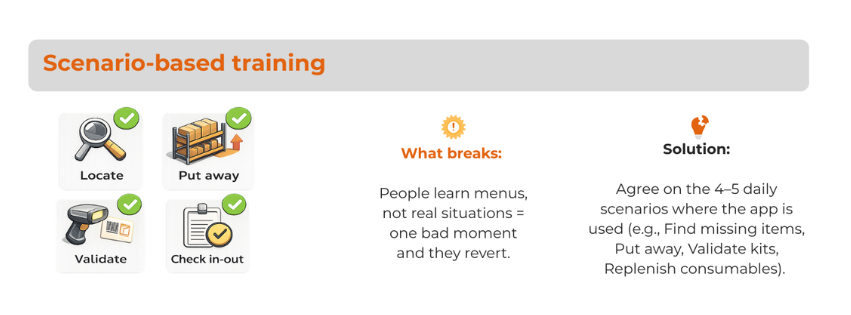
If you train people on screens and menus, you lose them. Operators don’t need to know every button. They need to succeed in the moment: find missing items, put away correctly, validate kits or containers, check in/check out shared assets, and handle unknown tags without panic.
Therefore, train by scenarios. Start with five: locate, handoff, putaway, validation, exception. Then, reinforce them with quick reference cards and a rapid-response loop in the first week. As a result, the floor doesn’t revert after the first bad experience. This is why the most common RFID implementation mistakes (and how to avoid them) is ultimately a training story, not a technology story.
Turn mistakes into a repeatable playbook
Here’s the upside: you can standardize these lessons. When you package exception flows, handoff definitions, zone validation steps, and scenario training into a lightweight pre-go-live checklist, you create repeatable deployments. Moreover, repeatable deployments create scalable channel revenue without turning every project into a custom services marathon.
So, if you only remember one thing from The most common RFID implementation mistakes (and how to avoid them), remember this: your best sales asset is a smooth go-live. When the first two weeks feel calm, customers expand. When expansion feels easy, partners win.