Inventory problems rarely start with one big mistake. More often, they begin with small moments of uncertainty.
A pallet arrives, but no one updates the system. A team moves a critical part to another area, but no one knows where it went. A returnable container leaves the facility and never comes back. A warehouse team packs a customer order with one missing item and discovers the mistake too late.
On paper, inventory exists. In reality, teams may not know exactly where it is, what condition it is in, or whether it is ready to move.
That gap between the digital system and the physical world creates real costs: manual searches, wrong shipments, production delays, duplicate purchases, stockouts, shrinkage, and frustrated customers.
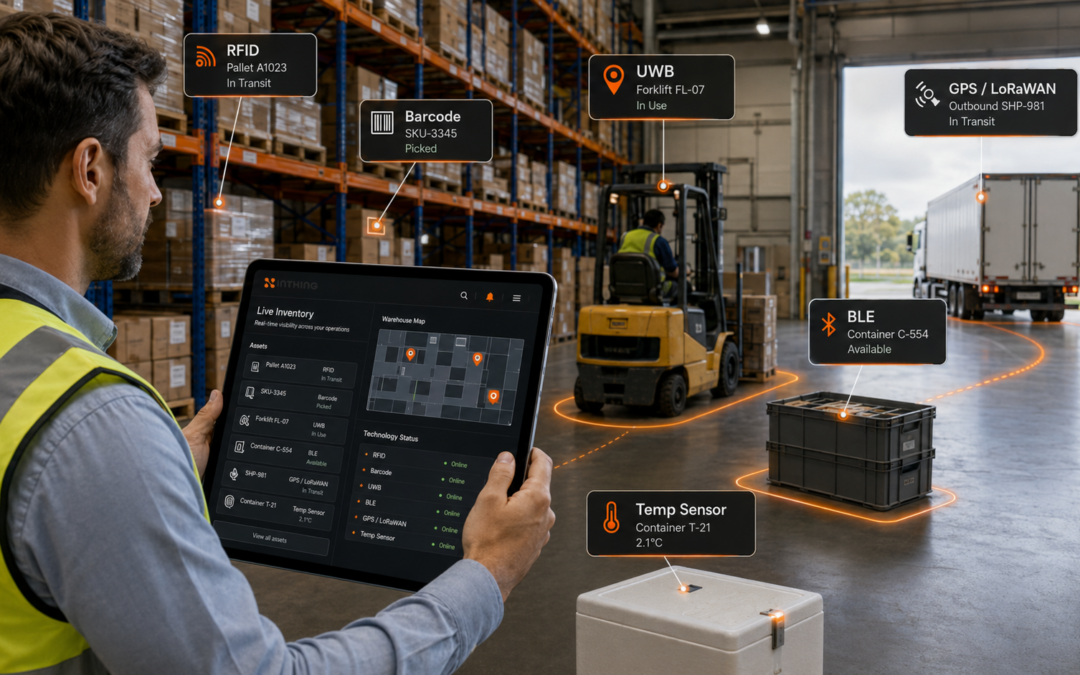
This is where sensor technology for inventory management creates measurable business value. By using technologies such as RFID, BLE, UWB, GPS, LoRaWAN, barcode scanning, environmental sensors, and connected industrial systems, companies can turn inventory from a static record into a live source of operational intelligence.
What Is Sensor Technology in Inventory Management?
Sensor technology connects physical items, assets, materials, and locations to digital systems.
In traditional inventory management, teams depend heavily on manual action. Someone scans a barcode, updates a spreadsheet, enters a transaction into an ERP system, or reports a movement after it happens.
That approach works until operations become too fast, too large, or too complex.
Sensor-based inventory management automatically captures events from the physical world. RFID can confirm that a pallet passed through a dock door. BLE can show that an asset is inside a specific zone. UWB can provide precise indoor location for high-value items. GPS can track shipments or outdoor assets. LoRaWAN can support long-range, low-power tracking across yards or distributed facilities. Barcode scanning can support controlled workflows where human confirmation still adds value. Environmental sensors can monitor temperature, humidity, vibration, or other conditions.
The technology captures the signal. The platform turns that signal into useful actions: inventory updates, alerts, dashboards, reports, audit trails, and workflow triggers.
That is the real value of sensor technology for inventory management. It not only collects data. It helps teams act faster and with more confidence.
Benefit 1: Real-Time Inventory Tracking and Visibility
Most companies already have inventory data. The problem is that this data often arrives late, misses context or depends on manual updates.
A system may say a material is available, but the team still has to search for it. A warehouse may show enough stock, but some of it may sit in the wrong location. A shipment may appear prepared in the system, but nobody has confirmed whether every item is actually on the pallet.
Sensor technology closes this gap.
With connected tags, readers, handheld devices, and location sensors, companies can see inventory movement as it happens. A material can trigger an update when it arrives. A worker can locate a tool without walking the entire floor. A team can verify a pallet before it leaves the dock. A shipment can remain visible even after it leaves the facility.
This changes daily operations. Instead of spending time asking where something is, teams can see its last known location, movement history, and current status.
The benefit is not just knowing more. The benefit is reducing uncertainty.
Benefit 2: Improved Accuracy and Efficiency
Inventory accuracy is not only a reporting issue. It is an operational issue.
If the system says an item is available and it is not, the business may make the wrong promise. If the system says something is missing, and it is actually on-site, the business may reorder unnecessarily. If teams correct inventory counts only during audits, they may operate with bad data for weeks.
Sensor technology improves accuracy because it captures real events automatically.
When an item moves through a reader zone, the system can update its status. When a worker scans a barcode at a process step, the system knows where that item is in the workflow. When a team verifies a shipment before departure, they can catch errors before those errors reach the customer.
This reduces the gap between physical inventory and system inventory.
A simple example is chemical tracking. In chemical environments, it is not enough to know that a container exists. Teams need to know when it arrived, where they stored it, whether someone moved it into an approved area, how long it stayed there and whether it requires special handling.
Sensor-based tracking creates a continuous digital trail. The same principle applies to raw materials, tools, medical equipment, finished goods, returnable containers, and production components.
Benefit 3: Reduced Labor Costs and Improved Productivity
One of the highest hidden costs in inventory management is the time spent looking for things.
People search for missing tools. Warehouse teams recount items that should already be accurate. Production supervisors walk the floor to check where jobs are stuck. Employees manually verify shipments under pressure.
This is not strategic work. It is recovery work caused by poor visibility.
Sensor technology reduces this burden by automating the collection of inventory and movement data. Instead of relying only on people to report every change, the environment itself becomes a source of information.
A warehouse worker can find the right item faster. A supervisor can see which jobs are delayed without calling every station. A maintenance team can locate equipment before service windows are missed. A shipping team can validate an outbound order before it becomes a customer complaint.
The productivity gain does not come from replacing people. It comes from removing unnecessary manual effort.
Benefit 4: Better Customer Experience
Customers do not see the internal complexity of inventory management. They see the outcome.
Did the order arrive complete? Did it arrive on time? Did the company ship the right product? Can someone answer where the shipment is?
Better inventory visibility directly improves customer experience because it reduces the errors customers feel most.
Before a shipment leaves the dock, RFID or barcode validation can confirm that the expected items are present. During fulfillment, location data helps teams pick faster and more accurately. During transit, GPS or long-range tracking can provide visibility beyond the warehouse. For returns, sensor-based workflows can identify items as soon as they re-enter the facility.
Teams reduce wrong shipments.
They prevent stockouts more easily.
They answer delivery questions faster.
They process returns with less delay.
The result is trust. A customer may never know which sensor technology works in the background, but they will notice that the company feels more reliable and easier to work with.
Benefit 5: Increased Security and Reduced Shrinkage
Shrinkage is often described as loss, but in many operations, it is really a visibility problem.
Items disappear because nobody knows where they last appeared. Assets leave approved areas without triggering an alert. Companies lose returnable containers when they do not monitor the full journey. Teams move high-value equipment without creating a reliable record.
Sensor technology helps reduce shrinkage by creating a stronger digital chain of custody.
The system can capture every movement.
It can record every zone entry or exit.
It can trigger alerts for exceptions.
It can show each item’s last-known location.
It can give audit historical movement data instead of forcing teams to rely on memory.
This matters for companies managing high-value tools, regulated inventory, medical devices, chemicals, IT equipment, documents, reusable containers, or critical production materials.
Security improves because teams can act sooner. Instead of discovering a missing item during the next audit, they can see when it moved, where the system last detected it and whether it crossed a boundary it should not have crossed.
Inventory Management Is Becoming Real-Time
Inventory management used to focus on records: what teams received, shipped, counted or entered into the system.
Modern operations need more than that. They need to know what is happening now.
That is the promise of sensor technology for inventory management. It gives teams real-time visibility, improves accuracy, reduces manual work, strengthens customer trust, and helps prevent loss before it becomes expensive.
RFID, BLE, UWB, GPS, LoRaWAN, barcode scanning, and connected sensors all play a role. But these technologies create the most value when they work together through one connected operational view.
Because the future of inventory management is not simply knowing what you own.
It is knowing where it is, what is happening to it, whether it is ready, whether it is safe, and what action should happen next.