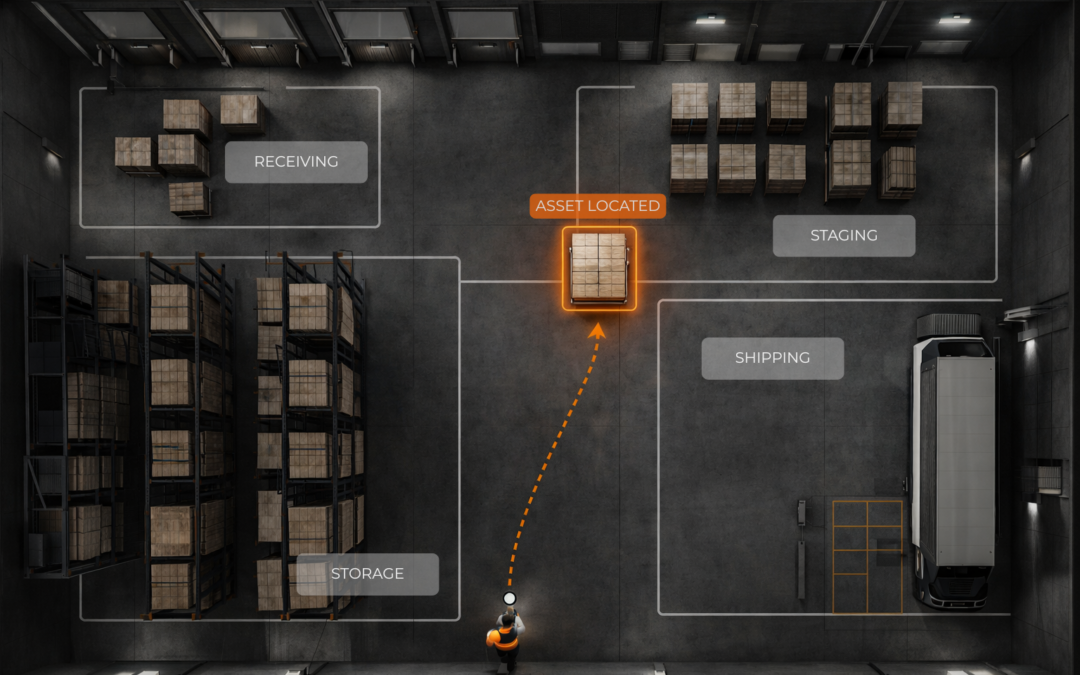
When warehouse companies begin evaluating an RFID project, the first questions are usually about speed, hardware, and accuracy. How quickly can tagged pallets be read? Which device is the right fit? How much time can RFID save in receiving, inventory, or dispatch workflows?
These are important questions. But they are rarely the complete set of questions.
One of the most overlooked questions in warehouse RFID projects is also one of the most important: once an asset has been detected, how will operators actually find it and act on that information inside the warehouse?
That question matters because in real warehouse environments, visibility only creates value when it supports action. It is not enough for the system to confirm that a pallet, roll cage, tote, or other tagged asset exists somewhere in the process. Warehouse teams need to understand where it is in a meaningful operational context, and what to do next.
Detection is only the beginning
In many RFID discussions, the focus naturally starts with tag reads. Customers want to know how reliably assets can be detected, how quickly data can be captured, and what hardware setup will perform best in their environment.
That is the right starting point. Reliable RFID performance is essential.
But warehouse workflows do not end when a tag is read.
A pallet may already be registered in the system, available for the next step, and technically visible. Yet operators may still lose valuable time trying to determine whether it is in the correct staging area, near the right dock door, in the right aisle, or waiting in a buffer zone elsewhere in the warehouse.
This is where many RFID projects face an important gap: “asset detected” does not automatically mean “asset found, verified, and ready for action.”
The real cost of limited visibility
That gap may seem small at first, but in day-to-day warehouse operations, it quickly becomes expensive.
When teams do not have enough context around asset location, the result is often familiar: unnecessary walking, extra manual checks, slower dispatch preparation, and more friction in exception handling. The asset may exist in the system, but if locating it still takes too long, the operational benefit is limited.
The issue is not a lack of data. The issue is a lack of usable visibility.
This is why warehouse companies should ask a broader question before launching an RFID project: what kind of visibility will operators actually need in order to work faster and with more confidence?
Knowing that an item is “in the warehouse” is rarely enough. In practice, teams often need location context that aligns with the warehouse workflow, receiving, staging, picking, storage, or shipping. They need visibility that is easier to interpret and easier to act on.
From RFID data to intelligent visibility
This is where RFID projects become even more valuable. The true strength of RFID isn’t just in capturing data quickly; it’s in transforming that data into actionable insights for operational teams. This helps users understand the location of assets, whether they are in the right place, and how they can respond promptly. Map-based visibility also becomes essential here.
Maps shouldn’t be seen as merely a visual addition or secondary feature. In warehouse operations, they can serve as a practical layer between RFID data and human decisions. Instead of simply indicating that a tagged asset has been detected, map-based visibility provides spatial context, helping operators identify the relevant zone, navigate more efficiently, verify asset placement, and resolve issues with less guesswork.
That’s what smart visibility looks like in practice. It’s not just about knowing an item was read; it’s about making RFID data more actionable, intuitive, and useful within everyday warehouse workflows.
Visibility must match the workflow
The value of RFID increases significantly when visibility aligns with the way warehouse teams actually work. Operators do not think in terms of raw read events. They think in terms of tasks, locations, and next steps. Is the pallet in the correct staging lane? Has it reached the right shipping zone? Is it still waiting in receiving, or has it already moved forward in the process?
This is why visibility should be designed around workflow context, not only around detection logic. When RFID data is presented in a way that reflects real warehouse zones and operational movement, teams can interpret information faster, make better decisions, and respond with less delay. That is what turns RFID from a data-capture tool into a practical operational system.
The best RFID projects go beyond tag detection
The most effective warehouse RFID projects are not the ones that simply read more tags. They are the ones that help teams locate assets faster, reduce friction in daily operations, and turn visibility into action.
Before starting an RFID project, the question is worth asking:
Not only can the system detect the asset, but can the operator quickly find it, understand its location, and act on it with confidence?
That is where RFID moves beyond identification.
That is where it starts delivering intelligent visibility.