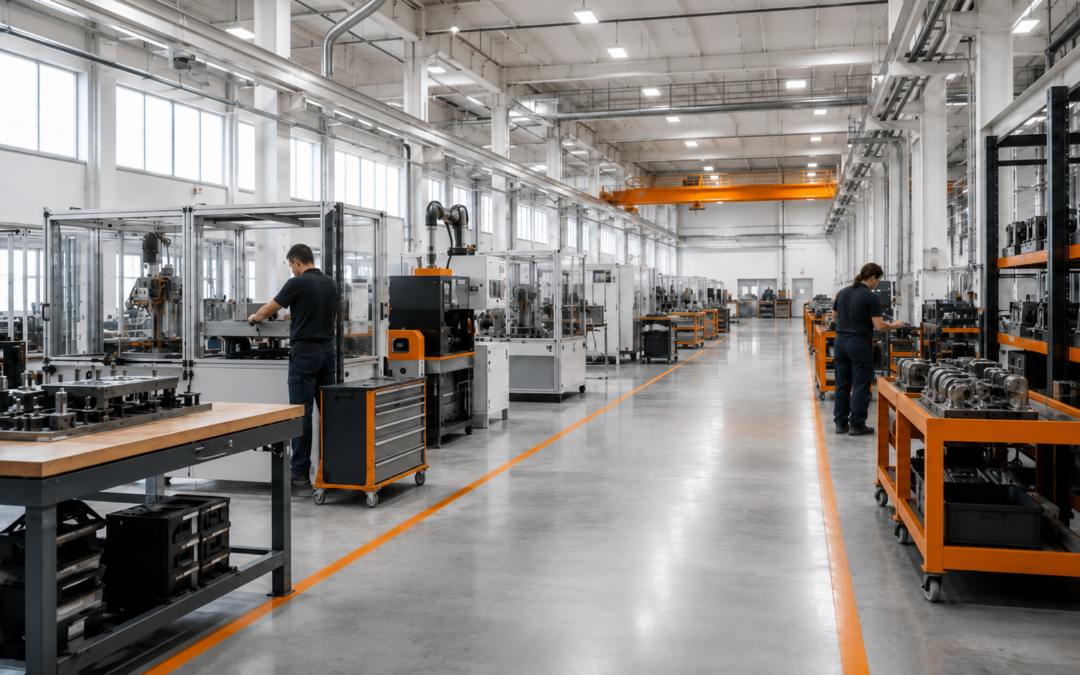
The team released the production order at 8:12 AM. By noon, nobody knew which workstation had it.
The traveler had left one station, but the next operator never registered it. The ERP still showed an active order. The production plan assumed work continued. On the floor, however, the job could have sat on a cart, waited beside a machine, moved to an unplanned area, or disappeared into a stack of similar paperwork.
Nobody had a reliable answer.
A job moves physically, but the data does not move with it. That gap creates a WIP blind spot, and even a small blind spot can disrupt the production schedule.
The Most Expensive Question on the Floor
“Where is the job?” sounds simple. In practice, the question often triggers calls, radio messages, spreadsheet checks, and physical searches.
A supervisor walks the line. An operator checks the staging area. Planning reviews the MES. Someone asks whether quality has the traveler. Another person searches carts near the previous workstation.
During that search, the job does not move. The team loses production time, while planners make decisions with incomplete information.
WIP visibility problems rarely look dramatic at first. One order waits twenty minutes longer than expected. Another misses a handoff. A third reaches the correct station without a timestamp. By the time managers recognize the pattern, the line has already lost capacity.
Why Production Systems Miss the Gap
ERP and MES platforms manage orders, schedules, inventory, and production records well. They still depend on timely, accurate updates from the floor.
When operators scan inconsistently, enter data late, or skip a transaction during a busy shift, the system loses contact with the physical job. The database shows what should happen, while the production floor tells a different story.
Paper travelers create an even larger gap. They move with the order, but they do not create a real-time event when they leave one station or reach another. A traveler can sit between two workstations for hours without triggering a warning.
The process creates the risk. Operators already run machines, move materials, inspect parts, and meet production targets. A stronger workflow captures movement as part of the work instead of adding another manual step.
What Real-Time WIP Tracking Changes
Real-time WIP tracking connects each job, traveler, batch, or production item to its actual location and status.
As a job moves, the system records its progress across workstations. Supervisors can open an indoor map and see the last known location. Dwell-time rules can flag an order that remains too long at one station or between two expected steps.
Instead of asking where the job went, the team can ask a better question:
Why has it stopped moving?
Location alone does not solve the production problem. Manufacturers also need context. Which workstation last handled the job? How long has it waited? Did it skip a stage? Does the next station have capacity? Has the job entered a recurring bottleneck?
Those answers turn production tracking into operational intelligence.
From Visibility to Bottleneck Analysis
Once the system captures every arrival, departure, and dwell period, production teams can measure cycle time with far more accuracy.
They can compare planned and actual cycle times, identify workstations that repeatedly create queues, and separate equipment constraints from process delays. Managers can also see whether jobs wait because of labor availability, quality checks, missing materials, changeovers, or scheduling decisions.
Without that event history, teams often blame the wrong part of the process. A machine may look slow because jobs accumulate nearby, while the previous station actually releases work in large batches. Quality may appear to create delays, while missing paperwork causes the real wait.
Real-time WIP data exposes those patterns before they become permanent habits.
How InThing Closes the WIP Blind Spot
InThing tracks jobs and travelers across more than 17 workstations, giving production teams a continuous view of movement through operational stages.
Dwell-time alerts notify supervisors when a job remains too long in one location. An indoor map shows where the system last detected the item. Real-time data exchange keeps the existing database or MES aligned with floor events, so teams can preserve their core production systems.
The same event stream supports cycle-time analysis, throughput measurement, and bottleneck detection.
In one production use case, InThing enabled real-time reconciliation of assembled and rejected items at worker stations. The operation supplied roughly 400,000 products annually and saved approximately $120,000 in labor previously spent on manual reconciliation.
The value did not come from “using RFID.”
It came from removing uncertainty from the production process.
Start With the Missing Handoff
Manufacturers do not need to digitize the entire factory on day one. A practical WIP visibility project can start with the handoff that causes the most disruption.
Track when each order leaves the previous station, when it reaches the next one, and how long it waits in between. Then connect those events to the tools that planners and supervisors already use.
Within a short period, the team can see whether the problem comes from missed registrations, staging delays, capacity constraints, routing errors, or unclear ownership.
The production floor already generates the movement. InThing turns that movement into reliable, real-time data.
The real question should never be:
“Where is the job?”
It should be:
“What do we need to do next to keep it moving?”