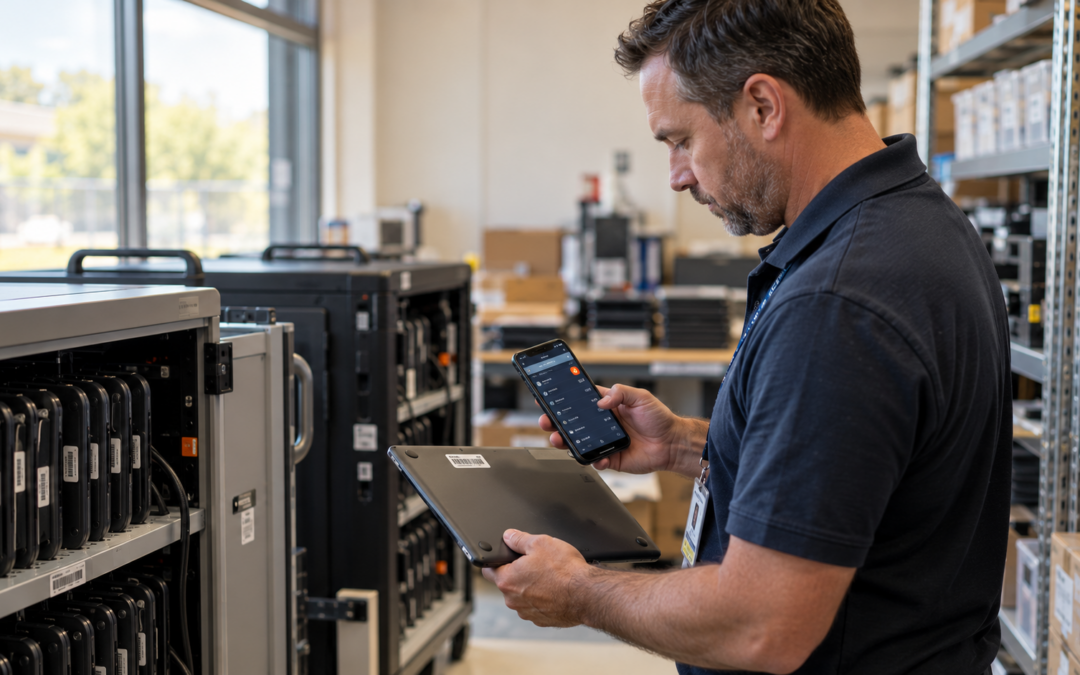
SLED asset accountability usually peaks once a year. Before fiscal year-end, a school district or county office prints a spreadsheet with thousands of rows. Then IT staff, facilities teams and a few reluctant volunteers walk the halls with barcode scanners, open closets and try to match records with reality. Eventually, the “location unknown” list grows again, and finance starts asking questions nobody can answer.
Why Manual Asset Audits No Longer Work for SLED Teams
In fact, three changes hit public sector teams at the same time.
ESSER money is gone, but the devices remain
First, the final ESSER obligation deadline passed on September 30, 2024. Districts used those funds to buy laptops, Chromebooks, and hotspots, and many of those devices now near the end of their useful lives. Some liquidation extensions ran into 2026, but none of them created new money for replacements.
Meanwhile, refresh cycles come out of regular budgets, and every missing device needs an explanation. Before finance approves a new order, IT needs clear answers. How many devices still work? Which ones sit unused in storage? Which ones can another school reuse?
Federal equipment rules changed
Second, OMB’s 2024 revision of the Uniform Guidance raised the federal equipment threshold from $5,000 to $10,000, or to the organization’s own capitalization level when that figure is lower. Items above the line still need property records and a physical inventory at least every two years.
Initially, that looks like relief. But a cart of thirty Chromebooks never crossed that line anyway. Besides, state rules and local policies often require tracking assets below it. Boards, auditors, and parents still expect your team to know where public assets are.
Device security now depends on asset visibility
Finally, in August 2026, CISA released its K-12 Cybersecurity Foundations package. One of its eight objectives focuses on safeguarding devices and assets. A lost laptop still carries credentials, data, and network access, and schools can’t protect devices they can’t find.
Continuous Assurance: An Idea SLED Teams Can Borrow From Finance
Finance teams faced a similar problem years ago, when annual sample reviews stopped catching issues early enough. Instead, many teams moved to continuous controls monitoring, where systems flag rule-breaking transactions the moment they happen.
Similarly, asset tracking for public sector organizations can follow the same model. Rather than counting more often, your team needs to stop relying on counts to find problems.
For example, define a short list of exceptions and watch for them every day:
- A device that hasn’t passed any checkpoint in 30 days
- An asset still assigned to an employee who left in June
- Equipment marked as disposed that still connects to the network
- A loaner device still missing since the summer program
When your team catches these in week one, each fix stays small. Otherwise, they wait for the annual audit and turn into write-offs and findings.
Where AI Helps (and Where It Doesn’t)
In practice, an AI agent can sort the morning’s exception list, compare it with HR departures, and draft a message to the right building principal.
However, AI can’t reconcile data nobody captured. When your records come from a once-a-year walk-through, AI simply analyzes an old snapshot faster. Above all, reliable, event-level data about asset location and custody comes first.
5 Steps to Continuous Asset Accountability
- Tier your assets. Track student devices, AV equipment, radios, and lab tools, but skip low-value consumables.
- Capture data at natural checkpoints. Issue desks, return carts, IT intake, and loading docks already see assets move every day.
- Start with barcodes. Later, add RFID or BLE where volume or movement justifies it.
- Assign an owner to exceptions. Twenty minutes a week beats three weeks of hallway walks.
- Give the annual audit a new job. Let it confirm what your team already knows, rather than reveal what it lost.
What Continuous Visibility Changes for Each Team
Better asset data gives every team a shared, current picture:
- IT assigns, redeploys, and recovers devices without guesswork.
- Finance reconciles assets faster, and plans refresh budgets with real usage data.
- Procurement checks available equipment before approving new purchases.
- Compliance teams prepare for audits with records they trust.
- Leadership sees where public money actually sits and how people use it.
How InThing Helps SLED Teams Make the Shift
InThing built InVault, its asset intelligence solution, for this kind of everyday accountability:
- Exception alerts, not annual surprises. InVault flags ghost assets, missed check-ins, and assets in the wrong place as they appear. Instead of a long spring list, your team works through a short weekly one.
- A complete history for auditors. Every scan builds a record of location, custodian, and condition. Then audit reports draw on real history, not on a spreadsheet someone last updated in March.
- Lifecycle data for refresh planning. InVault shows which devices people actually use, which need maintenance, and which sit idle. With that data, finance plans post-ESSER refresh cycles with evidence instead of estimates.
- Technology-agnostic by design. Start with barcodes, then add RFID, BLE, NFC, or GPS where they make sense.
- Mobile capture at real checkpoints. With VISIUM Mobile, staff scan assets at issue desks or IT intake while doing their normal work.
- Integration with the systems you already run. InVault connects to ServiceNow, Maximo, SAP, Oracle, Microsoft Dynamics, and Workday. It also supports REST APIs, SSO, and Power BI.
- Designed for small teams. Built to scale globally. Start with one school or one department, then expand across a district or state agency on the same platform.
The Bottom Line
Ultimately, the goal isn’t to pass the next audit. Instead, the goal is to know what you have, where it is, and who holds it, every day of the year. Accountability then stops behaving like a yearly crisis and starts running quietly in the background. Start small. Scale predictably.
Rethinking asset accountability in your organization? Then let’s compare notes.
References
- U.S. Department of Education: Education Stabilization Fund liquidation extensions
- eCFR: 2 CFR § 200.313 Equipment
- CISA: K-12 Cybersecurity Foundations