For years, companies have talked about asset tracking as if knowing where something is solves the whole problem. It does not.
Tracking answers a useful question: Where is the asset?
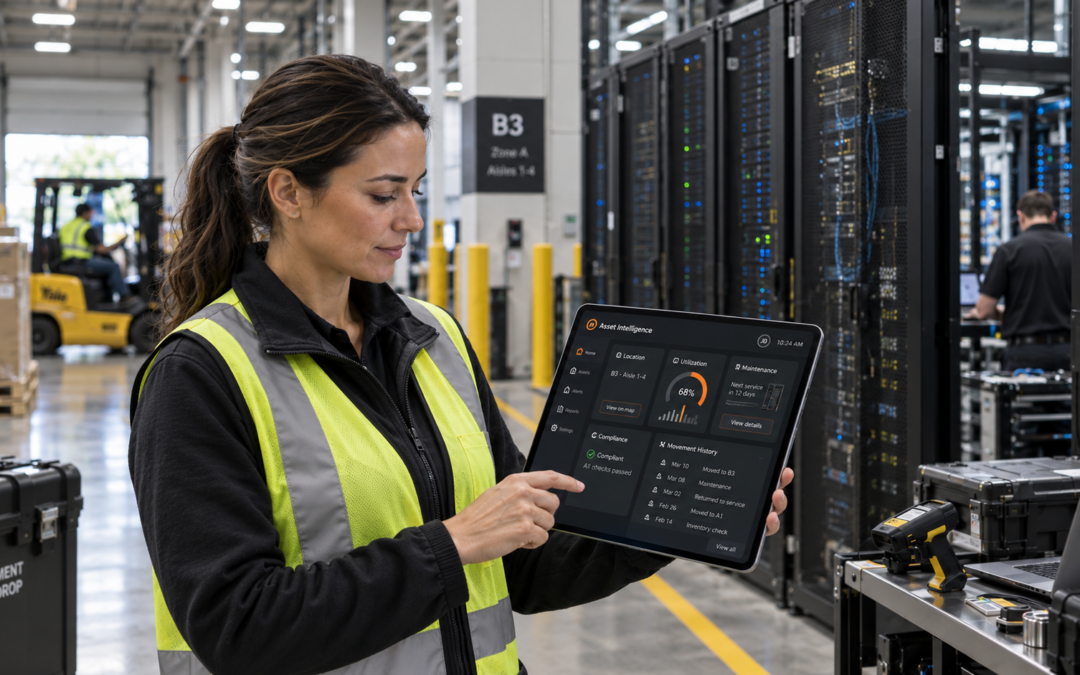
Asset intelligence goes further. It asks: Where is it, who is using it, how often is it used, when did it move, is it in the right place, does it need maintenance, is it compliant, and what should we do next?
That difference may sound small, but operationally it is enormous. Tracking gives you a dot on a map. Asset intelligence gives you context, history, risk, and a reason to act.
From location to understanding
Traditional asset tracking usually focuses on identification and location. A barcode scan confirms that a laptop entered a room. An RFID read tells you that a tool passed through a doorway. A BLE tag shows that equipment is somewhere inside a defined zone.
Those signals matter. However, on their own, they still leave people doing the thinking.
Asset intelligence connects those signals with business rules, asset records, workflows, maintenance schedules, utilization data, ownership, transfers, alerts, and audit history. As a result, the system does not simply tell you what happened. It helps you understand what that event means.
Imagine a calibration-sensitive device entering a production area. Tracking tells you it arrived. Asset intelligence can immediately recognize that its certification expires next week, verify whether it belongs in that zone, record the movement, update the responsible team, and trigger an action before the device creates a compliance problem.
That is a very different level of visibility.
Why this matters in real operations
Consider a data center. Teams manage servers, networking equipment, tools, test devices, replacement hardware, and other high-value assets across secure rooms and multiple facilities. Knowing that a device exists is not enough. Operations teams need movement history, ownership, authorized zones, maintenance status, and a reliable audit trail. When every change becomes part of a continuous asset record, security and operational control stop depending on spreadsheets and memory.
The same principle applies in warehouses and manufacturing environments. Forklifts, pallet jacks, specialized tooling, jigs, fixtures, scanners, and shared equipment constantly move between people and work areas. Basic tracking can show where an item was last seen. Asset intelligence can reveal that one forklift sits idle while another is overused, that a critical tool has not returned to its assigned area, or that equipment is approaching a service threshold. Suddenly, visibility becomes a productivity tool, not just a search tool.
Public-sector organizations face another challenge: accountability. Cities, counties, agencies, laboratories, and government facilities often manage thousands of devices across departments, buildings, and users. Audits can consume weeks because teams must reconcile physical assets with records. Asset intelligence creates a continuous, timestamped history of location, movement, ownership, transfers, maintenance, and retirement. Therefore, the audit trail becomes part of daily operations instead of a stressful project that begins when someone asks for evidence.
What does asset intelligence actually change?
The real benefit of asset intelligence is not simply having more data. It is having fewer operational questions that nobody can answer.
Teams spend less time searching for equipment because they can see where it is and where it has been. Procurement can avoid unnecessary purchases because managers know what assets already exist and whether they are actually being used. Maintenance teams can act before equipment becomes unavailable, while compliance teams gain a reliable history of movements, inspections, certifications, and ownership without rebuilding that history before every audit.
At the same time, utilization data reveals another layer of value. An organization may discover that some equipment is constantly overbooked while similar assets sit unused elsewhere. High-value items can trigger alerts when they leave an authorized area. Assets that have effectively disappeared from operations can be identified, investigated, transferred, or retired instead of remaining indefinitely on the books.
In other words, asset intelligence turns visibility into measurable operational control. It helps organizations find faster, buy smarter, maintain earlier, audit easier, reduce loss, and get more value from the assets they already own.
The real value appears between events
This is the biggest mindset shift.
Asset tracking focuses on events. An asset entered. It moved. It left.
Asset intelligence focuses on what happens between those events.
How long has the asset been idle? Is it being used enough to justify owning it? Did it leave an authorized zone? Has it missed a maintenance window? Is another department about to purchase equipment that already exists elsewhere? Are “ghost assets” still sitting on the books even though nobody can physically locate them?
Those questions connect physical visibility with financial control, operational performance, compliance, and risk.
They also change behavior. People spend less time searching. Teams make fewer duplicate purchases. Maintenance becomes proactive. Audits become easier. Managers see underused equipment before buying more. Security teams respond to unusual movement immediately rather than discovering a loss during the next inventory count.
Beyond “Where is it?”
The future of asset management is not a better map.
It is a better understanding of every asset throughout its lifecycle, from procurement and deployment to utilization, maintenance, audit, transfer, and retirement.
That is the idea behind asset intelligence: turn physical events into operational knowledge, and turn operational knowledge into action.
Once an organization reaches that level of visibility, going back to spreadsheets, manual searches, disconnected scans, and periodic audits feels almost impossible. The question changes from “Can we track our assets?” to something far more valuable:
“What could we improve if every asset could continuously tell us what we need to know?”