Many organizations begin their visibility journey with a technology decision. They choose RFID to track assets, barcodes to manage inventory, GPS to monitor vehicles, BLE to locate equipment, or sensors to measure environmental conditions. In the right context, each of these technologies can solve a real operational problem and deliver measurable value.
However, the challenge begins when one technology becomes the entire strategy.
Operational environments rarely fit into a single technical category. A warehouse, hospital, factory, logistics network, retail operation, or field service organization does not run on one type of asset, one type of movement, one type of location, or one type of data. Instead, it operates through layers of activity. People move between zones. Goods pass through multiple checkpoints. Tools disappear, equipment changes status, vehicles leave controlled environments, and conditions such as temperature, humidity, shock, and utilization influence daily decisions.
As a result, a single-technology mindset may solve one use case, but it often limits the next ten.
The Problem with Single-Technology Thinking
Single-technology thinking usually starts with a valid need: “We need to know where our assets are,” or “We need faster inventory counts,” or “We need proof that items moved through the right process.”
From there, the organization selects the technology that best fits the immediate use case. RFID may improve bulk scanning. Barcodes may create low-cost item identification. GPS may provide outdoor location. BLE may support proximity-based tracking, while sensors may capture condition data. In many cases, these choices are completely reasonable.
Nevertheless, once the business need expands, the limitation becomes clear.
RFID may not work for every material, distance, or physical environment. Barcode scanning depends on human interaction and line of sight. GPS loses value indoors. BLE provides useful proximity, but it may not deliver the precision required for every process. RTLS can offer high accuracy, although it may not be necessary or cost-effective for every asset. Meanwhile, sensors create valuable context, yet they do not automatically explain process flow.
Therefore, the question should not be, “Which technology should we use everywhere?”
A better question is, “Which combination of technologies gives us the intelligence we need?”
That shift changes everything.
Customer Environments Are Hybrid by Nature
Modern operations are already hybrid. They combine legacy systems, manual workflows, automated processes, physical assets, mobile teams, third-party providers, and multiple data sources. Visibility gaps appear because these parts rarely speak the same language.
For example, one site may need RFID portals at dock doors. Another may rely on handheld barcode scanning. A yard may require GPS tracking, while a hospital department may benefit from RTLS. At the same time, a cold chain operation may depend on temperature sensors, and a manufacturing line may need a mix of identification, location, and condition monitoring.
This does not mean the environment is fragmented by design. Rather, it shows that the real world is complex.
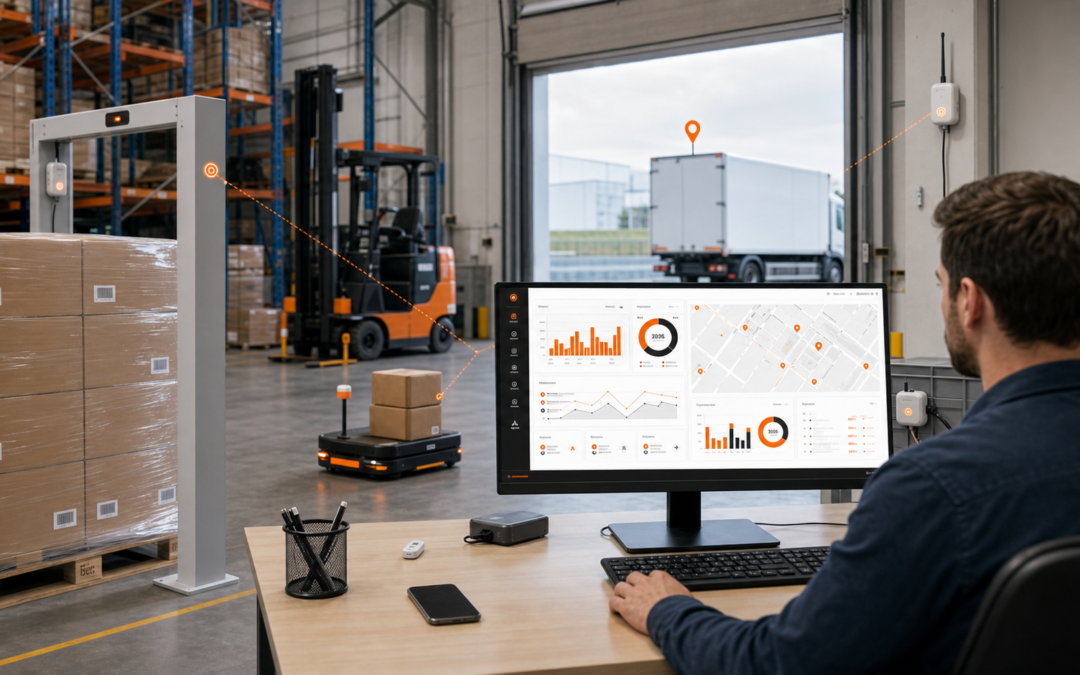
A strong operational intelligence strategy accepts that complexity instead of forcing every process into one technical model. It allows each technology to do what it does best, while the platform connects the data into a unified operational picture.
That is where value grows.
The Role of RFID, Barcode, RTLS, BLE, GPS, and Sensors
Each technology plays a specific role in the visibility ecosystem.
RFID enables fast, automated identification without requiring direct line of sight. Because of that, it works especially well when many items need to be read quickly, such as pallets, containers, tools, garments, medical assets, or inventory moving through choke points.
Barcode remains powerful because it is simple, affordable, and widely adopted. It supports controlled process steps, confirmations, and item-level identification where manual scanning makes sense.
RTLS provides real-time location awareness inside facilities. It helps organizations understand where critical assets, equipment, or people are within complex indoor environments.
BLE supports proximity, zone-based tracking, and cost-effective location use cases. In practice, it can be a smart choice when full precision is not required but contextual visibility still matters.
GPS extends visibility beyond the building. It supports fleets, containers, field assets, and mobile operations across wider geographic areas.
Sensors add another dimension: condition. They show not only where something is, but also what is happening to it. Temperature, humidity, vibration, shock, motion, pressure, and other signals can turn simple tracking into meaningful operational insight.
When these technologies work separately, they create isolated data points. However, when they work together through a platform, they create intelligence.
Why a Platform Approach Creates More Value
A platform approach moves the conversation away from devices and toward outcomes.
Instead of building one isolated solution for asset tracking, another for inventory, another for fleet visibility, and another for environmental monitoring, organizations can create a shared intelligence layer across operations. This layer collects data from different technologies, normalizes it, connects it with business systems, and turns it into actions.
This matters because operational value rarely comes from knowing one fact. More often, it comes from understanding the relationship between facts.
Where is the asset?
Who used it last?
Did it pass the right checkpoint?
Was it exposed to the wrong temperature?
Is it available, idle, delayed, misplaced, or at risk?
Which process keeps creating exceptions?
Where does the organization lose time, capacity, or money?
These questions require more than identification. They require context.
For that reason, a technology-agnostic operational intelligence platform makes it possible to start with one use case and expand without rebuilding from scratch. It supports different hardware, different data sources, different environments, and different levels of process maturity. Additionally, it reduces the risk of locking the organization into a technical path that may not fit future needs.
How InThing Builds Scalable Intelligent Visibility Offers
InThing approaches visibility as an operational intelligence challenge, not a single-device deployment.
The goal is not to push one technology into every environment. Instead, the goal is to design the right architecture for the process, the asset, the location, the data requirement, and the business outcome. Depending on the use case, that architecture may include RFID, barcode, RTLS, BLE, GPS, sensors, or a combination of them.
By connecting these technologies through a scalable platform, InThing helps organizations build visibility offers that can grow over time. A project can begin with asset tracking in one department and then expand to inventory, maintenance, utilization, compliance, logistics, or process optimization.
In this way, organizations can move from tactical improvement to strategic intelligence.
From One Use Case to Enterprise-Wide Intelligence
The most valuable visibility strategies do not stop at the first successful use case. They use it as a foundation.
A company may begin by tracking high-value assets. Over time, the same data can support utilization analysis, improve availability, reduce unnecessary purchases, and connect asset movement with maintenance, compliance, or workforce activity.
The same pattern applies across industries. Inventory visibility becomes process visibility. Location data becomes utilization insight. Sensor data becomes quality assurance. Movement history becomes compliance evidence. Exception alerts become an operational improvement.
Ultimately, this is the real promise of technology-agnostic operational intelligence: it does not force operations to adapt to one technology. Instead, it allows technology to adapt to the reality of operations.
Organizations do not need more disconnected tracking projects. They need intelligent visibility that can scale across assets, people, places, conditions, and processes.
That is how operational intelligence moves from a narrow technical solution to a long-term business capability.