
- Maturity
- Pilot (proof of concept) completed successfully at one customer site; production scope being agreed
- Where
- A life-sciences manufacturer’s warehouse in California
- Hardware
- PAL Robotics STOCKBOT autonomous mobile robot with an on-board RFID reader, plus fixed overhead RFID readers
- InThing software
- EAI-Bridge (upload connector) · Trapeze · Visium (floor plans, locations, inventory) · InFlow
The problem
Many warehouses already put RFID tags on their pallets and products, yet still send people to count the racks by hand to keep inventory accurate. It is slow, repetitive work, and the moment the count ends, it starts going out of date.
What we set up
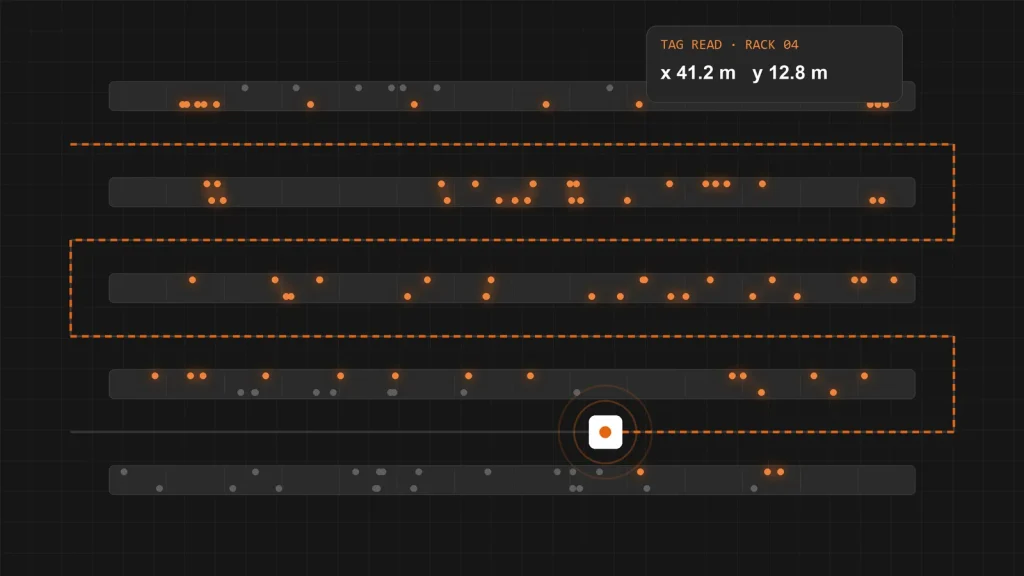
STOCKBOT drives the aisles on its own, usually at night, and reads every RFID tag it passes. Fixed overhead antennas watch the same racks around the clock. The robot reads the lower rack levels best and the ceiling antennas the upper ones, so together they cover the whole rack.
- No manual steps. After each run the robot uploads its reads through a secure connector in EAI-Bridge. Nobody copies files or walks the aisles.
- One map. The racks are drawn on the robot’s own map in Visium, so every read lands on a real rack location that people and the ERP understand.
- One inventory picture. Robot reads and overhead reads sit side by side with handhelds and dock doors.
- Exceptions, not cycle counts. Visium lists what is expected but not seen, and what is seen but not expected, each with the last place it was read.
The result
The proof of concept met its goals. Every pallet with a working tag was found without anyone walking the aisles, and each pallet was located in the right section of the rack. Each exception Visium raised was explained with a single check on the racks: a retrieved pallet still on the record, tags that needed attention, and old labels that should have been removed.
What we learned
- Two layers beat one. A mobile reader and fixed readers cover each other’s blind spots on tall racks.
- Labels matter as much as readers. Metal equipment and label placement decide whether a tag answers at all, so labeling rules are part of the rollout.
- Maps have to agree. Aligning the robot’s map with the floor plan is now a standard commissioning step.
What’s next
We are agreeing the production scope with the customer: which aisles, the antenna layout and the robot’s nightly schedule.
Interested in autonomous inventory for your warehouse or data center? Talk to us.